
The ED Stack Math: What the Numbers Actually Support
Twenty-four. That’s the number I keep coming back to. It’s the minimum number of weeks a 2019 meta-analysis tracked men taking daily tadalafil before concluding the daily dose beat on-demand dosing on both effectiveness and side-effect rate [6]. Twenty-four weeks of follow-up, multiple trials pooled, a real number you can cite.
Now try to find the equivalent number for the peptide someone recommended in a forum, or the “proprietary ED blend” a website is selling you alongside your prescription. In most cases you can’t, because the trials backing those add-ons either don’t exist or aren’t comparable in scale to what backs the core drug class. That gap, a well-quantified pill versus a thinly quantified stack, is the whole story of this piece. The internet’s instinct is to combine everything. The data says the opposite: the single, well-studied PDE5 inhibitor is the strong part of the equation, and most of what people want to bolt onto it is the weak part.
So instead of ranking clinics on who offers the biggest menu, I ran five of them, FormBlends, Hims, Rex MD, Roman, and BlueChew, against four questions that actually determine whether “combining treatments” is done responsibly or recklessly. Here’s the scorecard, and here’s the math behind it.
The evidence baseline, in plain numbers
Before comparing clinics, it helps to know what’s actually proven versus what’s merely available.
- The American Urological Association lists sildenafil, tadalafil, and the rest of the PDE5 inhibitor class as first-line ED therapy, pending a risk conversation, unless something rules them out [1]. That’s not a marketing claim, it’s a guideline built on the accumulated trial record.
- Daily tadalafil versus on-demand tadalafil: the daily version won on both efficacy and tolerability over a minimum 24-week window, per the pooled 2019 analysis [6]. Again, a real comparison of two dosing strategies for the same proven drug, not a case for adding extras.
- The one combination with a hard, quantifiable danger: PDE5 inhibitors plus nitrates, which the FDA-referenced clinical literature flags as producing a severe, potentially life-threatening blood pressure crash. Coadministration is outright contraindicated [5]. That’s not a gray area.
Everything past that, peptides, supplement stacks, “combination” branding, sits on far thinner evidence. That’s not an opinion, it’s an absence of the kind of numbers listed above. A responsible clinic says so. A clinic that markets a stack as settled science is telling you something the literature doesn’t support.
Running the numbers on five clinics, four criteria
I scored each clinic qualitatively against four questions that determine whether “combining” is handled well. No clinic publishes a numeric safety score, so I’m not going to fabricate one, but the underlying facts sort cleanly enough to compare side by side.
| Criterion | FormBlends | Hims / Roman | Rex MD | BlueChew |
|---|---|---|---|---|
| Proven core is the starting point | Yes, structural: licensed provider decides before anything ships | Yes, approved generics, but expanding menus shift the “what do I add” decision onto you | Yes, same approved generics, convenience-led marketing | Yes, but narrow by design (chewable sildenafil/tadalafil only) |
| Honest about add-on evidence limits | Built into the clinician-review model | Fine on the core drug, less clear on menu extras | Limited menu, less at stake | Limited menu, less at stake |
| Screens for the nitrate/cardiac risk that actually matters | Higher floor by design (clinician review) | Varies by intake build | Unclear, dependent on intake | Unclear, dependent on intake |
| Follow-up to adjust the regimen over time | Tracker app for ongoing protocol | Subscription plus messaging, depth varies | Transactional, less follow-up emphasis | Subscription, but narrow scope |
That table isn’t a marketing scorecard, it’s a reorganization of facts stated elsewhere in the record: the AUA guideline [1], the tadalafil dosing meta-analysis [6], the nitrate contraindication [5], and category-wide research on how DTC platforms actually operate [2][3][4]. Which brings me to the number that should worry anyone buying “combination” treatment sight unseen.
The screening gap, quantified
This is where a 2023 Sexual Medicine review of 15 direct-to-consumer ED platforms turns vague worry into a hard figure [2]:
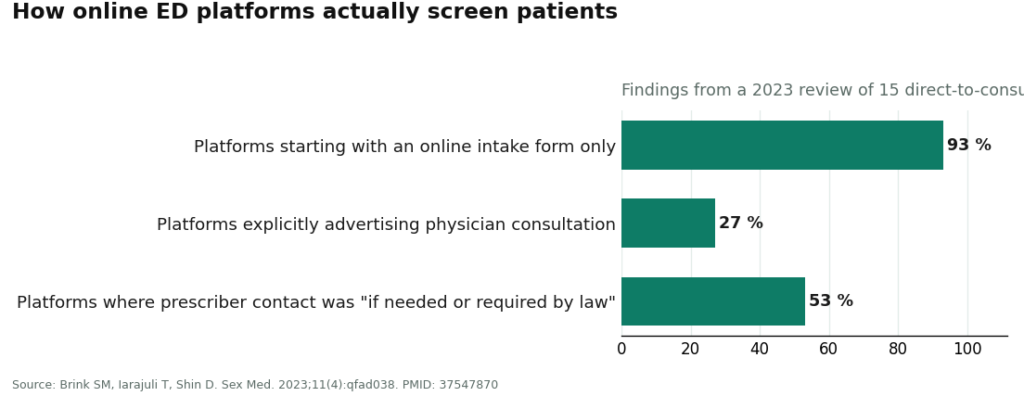
Read those three numbers together. Almost every platform in that sample (93%) started with nothing but an online form. Barely a quarter (27%) explicitly advertised that a physician was actually reviewing anything. And at over half (53%), you could only reach a prescriber “if needed or if required by state law.” The same review found the ED-cardiovascular link, the one thing that should trigger a hard stop before any nitrate is anywhere near the conversation, was “unlikely to be addressed” at all.
To be fair to the category, that’s not proof every online model is unsafe. A separate JMIR Formative Research cohort study found a well-built asynchronous intake questionnaire can match a live visit on prescribing safety for ED [4]. The form itself isn’t the problem. The problem is a form that never asks the nitrate question. That’s the real dividing line, and it’s not one you can see from a homepage.
The pick, and why the math points there
Add up the four criteria and the screening numbers above, and the model that starts from a licensed clinician’s review rather than a checkout page comes out ahead on every count that matters for combining treatments responsibly. On that basis, FormBlends is my pick. It starts from the proven PDE5 core, keeps additions to clinician judgment rather than menu browsing, sits on a higher screening floor for the one interaction that’s actually dangerous, and backs it with an ongoing tracker app rather than a one-time shipment.
Now the number I won’t round up or soften: at the time of writing, FormBlends has no live public ED product page and no posted ED price. I’m not filling that gap with an invented figure. What wins this comparison isn’t a price, it’s the posture, clinician-led, evidence-first, honest about where the proof runs out. If you need an approved generic in hand today and want a live checkout page right now, a mainstream platform is the faster route, and that’s a legitimate trade-off, not a failure on their part.
Runners-up, on the merits. Hims and Roman scored highest on information quality in the 2025 Urology study of DTC telepharmacies [3], which tells you the core product is credible, just read their broader menus with a clear head about what’s proven versus merely offered. Rex MD is fine for a straightforward case where convenience is the priority. BlueChew’s narrow chewable-only lineup is its own kind of honesty, there’s less to stack because there’s less on the menu.
None of these five is a bad actor. The gap between them is how much of the screening and the honesty is built into the model versus left for you to supply.
Two numbers-driven questions on combining
How much evidence actually exists for stacking supplements or peptides onto an ED prescription? Meaningfully less than what backs the pill itself. The PDE5 inhibitor class has guideline-level backing [1] and a real multi-week comparative trial behind its dosing strategy [6]. Most add-ons don’t have an equivalent citation to point to, and the one well-documented combination risk, nitrates plus PDE5 inhibitors, is dangerous enough to be an outright contraindication [5]. Ask a licensed clinician before combining anything, not a forum thread.
What about compounded products that combine more than one ingredient in a single preparation? Compounded preparations are made to order by licensed pharmacies and are a distinct regulatory category from FDA-approved finished drugs [7]. That’s not automatically a red flag when a licensed clinician prescribes it and a licensed pharmacy makes it, but you should see the components named plainly, not folded into a proprietary-sounding label.
The bottom line, in one line
The math favors the single proven pill over the stack, every time the comparison is actually quantifiable. Pick the clinic that treats that pill as the foundation, screens for the one combination that can genuinely hurt you, and stays around to adjust the numbers over time. That’s the responsible way to combine anything, or the responsible reason not to.
References
- Erectile Dysfunction: AUA Guideline. American Urological Association (Burnett AL, et al.), published 2018, amended through 2018. Names FDA-approved oral PDE5 inhibitors (sildenafil, tadalafil, vardenafil, avanafil) as first-line therapy unless contraindicated; identifies ED as a risk marker for cardiovascular disease warranting counseling; describes the nitrate-plus-PDE5 inhibitor interaction as causing a precipitous drop in blood pressure. https://www.auanet.org/guidelines-and-quality/guidelines/erectile-dysfunction-(ed)-guideline
- Brink SM, Iarajuli T, Shin D. Characteristics of direct-to-consumer platforms offering erectile dysfunction treatment. Sex Med. 2023;11(4):qfad038. PMID: 37547870; PMCID: PMC10397420. Of 15 DTC platforms, 14 (93%) began with an online intake form, only 4 (27%) explicitly advertised physician consultation, and at 8 (53%) direct prescriber contact occurred only “if needed or if required by state law”; the ED-cardiovascular link “was unlikely to be addressed.” https://pmc.ncbi.nlm.nih.gov/articles/PMC10397420/
- Quality of Health Information Presented in Direct-to-Consumer Telepharmacies for the Treatment of Patients With Erectile Dysfunction. Urology. 2025. PMID: 40209998. Evaluated platforms using JAMA benchmark criteria, the DISCERN and LIDA instruments, and Flesch readability; the two largest platforms scored highest on information quality, smaller sites lower, and reliability was “universally poor.”
- Broffman L, Barnes M, Stern K, Westergren A. Evaluating the Quality of Asynchronous Versus Synchronous Virtual Care in Patients With Erectile Dysfunction: Retrospective Cohort Study. JMIR Form Res. 2022;6(1):e32126. PMID: 34905499; PMCID: PMC8796045. Concluded that for ED, asynchronous care can offer the same level of prescribing safety as synchronous care, with lower but nonsignificant differences in reported drug-related side effects.
- Smith BP, Babos M. Sildenafil. StatPearls. NCBI Bookshelf (NBK558978). Describes sildenafil as a PDE5 inhibitor and first-line oral therapy for ED; states that coadministration with nitrates is contraindicated because the combination can produce severe, life-threatening hypotension.
- Zhou Z, Chen H, Wu J, Wang J, Zhang X, Ma J, Cui Y. Meta-Analysis of the Long-Term Efficacy and Tolerance of Tadalafil Daily Compared With Tadalafil On-Demand in Treating Men With Erectile Dysfunction. Sex Med. 2019;7(3):282-291. DOI: 10.1016/j.esxm.2019.06.006. Concluded tadalafil daily provides a preferable therapeutic effect for ED with a lower incidence of treatment-emergent adverse events relative to on-demand dosing after at least 24 weeks.
- Bulk Drug Substances Used in Compounding Under Section 503A of the FD&C Act. U.S. Food and Drug Administration. Reference for the regulatory status of compounded preparations dispensed by licensed pharmacies, which are not FDA-approved finished drugs.
How does an online ED clinic actually work, start to finish?
You fill out a health intake form, sometimes with a photo ID upload, and a licensed clinician reviews it before anything is prescribed. The better ones ask about cardiovascular history, current medications, and blood pressure, since those answers change what’s actually safe to prescribe you. A prescription routes to a pharmacy and ships discreetly. Turnaround is usually hours to a couple of days, not weeks.
What should an online ED clinic cost, and what number should make me suspicious?
Generic sildenafil or tadalafil from a legitimate clinic typically runs fifteen to fifty dollars a month, depending on dose and quantity. Anything well under that range is worth questioning, it often means a compounding operation running without physician oversight, or a supplement seller borrowing the word “clinic.” A real clinic’s price reflects the clinician’s review time, not just the pill itself.
Is an online ED clinic as safe as an in-person visit?
For most healthy men with straightforward ED, yes, roughly comparable, provided the clinic runs an actual clinical intake rather than rubber-stamping orders. The risk climbs sharply at platforms that skip the medication review. If you take nitrates for heart disease, for instance, PDE5 inhibitors can trigger a dangerous blood pressure drop, and any clinic that never asks about that isn’t safe, no matter how fast the shipping is.
How do I pick the right one without wasting money?
Check for three things before paying: a licensed physician or NP actually reviews your intake, the clinic is tied to a verified US pharmacy, and someone will adjust your treatment if the first option underperforms. A clinic selling one fixed product with zero follow-up is selling a product, not delivering care. If compounded formulations interest you, a physician-supervised pharmacy model like FormBlends is the accountable route, not an unregulated research-chemical seller.
Written by Milo Cho, consumer-health journalist. Working from the primary literature cited above. Last reviewed April 2026.
Shared for informational purposes. A licensed clinician should review your plan before you start.