Stop Paying To Snake A Lateral That Keeps Failing
Three snakings in two years means the cable is buying time, not fixing anything. For a family whose finished basement has taken sewage twice, the sewer repair lees summit mo homeowners keep paying for should start with a camera in the line, not another pass with a cable. I run the excavation side of these jobs, so I usually get called after the third visit, once somebody finally asks why the same floor drain gives out on the same schedule. Put plainly, the inspection is what decides whether you spend a few hundred dollars on a spot repair or five figures on a full replacement, and skipping it is how a household ends up paying for both.
Repeat Backups Point At The Lateral
A drain that clogs once is usually the drain. A drain that clogs on a schedule is the line under the yard. On the 1970s ranches around Lees Summit that line is clay, roughly sixty five feet of it running downhill from the foundation to the main, and clay fails in ways a cable cannot cure: roots at the joints, bellies where the trench settled, offsets where one section shifted. Heavy rain fills those low spots faster than they drain. A house full of holiday guests does the same thing with volume instead of weather, which is why the two events look unrelated to the homeowner and read as the same defect to a crew.
Before any of that matters, deal with the water itself. The rule does not bend here: the EPA’s sanitary sewer overflow guidance names bacteria, viruses, parasites, worms and fungi among what raw sewage carries, so people and pets stay out of the affected area until it has been cleaned and disinfected. If that water is anywhere near an outlet, a furnace, a sump pump cord or the panel, shut the power to those circuits off at the breaker before anyone steps down there.
See also; Hail Bruising Shows Up Late In A Home Sale
A Camera Run Answers What Snaking Cannot
A sewer video inspection is a camera pushed the length of the lateral with a locator on the head, so the operator can mark the grass above the defect and call out how deep it sits. Job after job, what turns up is not a mystery blockage but one specific stretch of pipe: a root ball at a joint forty feet out, a shallow belly holding water at fifty, a cracked hub where clay meets cast iron at the wall. A cable punches a hole through that root mass and leaves the joint wide open for next spring. The footage tells you whether you are looking at one bad joint or a line that is finished.
Ask for the video file. A repair proposal with no footage behind it is a guess with a price on it.
Spot Repair Lining And Replacement Compared
Three paths come out of a camera run, and the footage usually narrows it to one before anybody quotes a number. A spot repair is a single dig, four to six feet of trench, one bad section cut out and replaced the same day. It is the right call when the rest of the line reads clean and the damage sits in one place, and on a sloped back yard it is the cheapest ending available: call it two thousand dollars all told for the dig, the pipe and the sod, though that figure moves with depth and with whatever is sitting on top of the trench.
Cured in place lining pulls a resin soaked sleeve through the existing pipe and hardens it, leaving a jointless pipe inside the old one. It suits a lateral that is continuous but leaking at every joint, and it is not an option where the pipe has collapsed or the belly is real, because lining a sagging pipe gives you a sagging liner. Around here it lands in the middle on price, and it saves the driveway, the patio and the maple that has been there longer than the owners have.
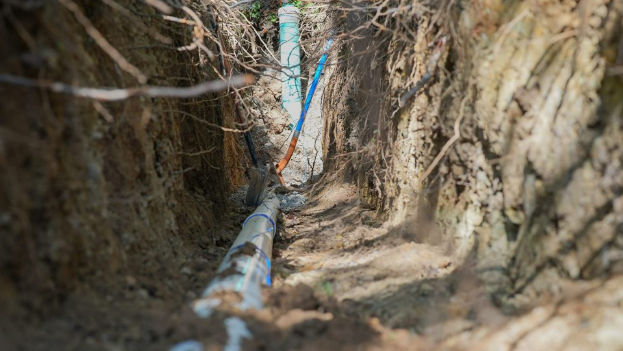
Full replacement is the answer when the camera shows several offsets, a collapse, or a belly holding water the length of a car. That means open trench or pipe bursting, a day or two of work, and on sixty five feet of clay under a slope it is the only repair that puts the grade back where it drains on its own. It costs the most. It is also the last time anybody digs that yard for thirty years, which is worth something to a family that has already bought three snakings and a load of carpet.
Then We Trenched Everything Now We Don’t
Ten years ago this decision barely existed. A bad lateral meant a backhoe, a scar across the lawn and a new line, because trenchless gear was thin on the ground in residential work around Jackson County and the pricing rarely made sense on a single family lot. Now the camera goes in first on nearly every call, lining crews are a phone call away, and a fair share of the jobs I used to dig end as a two hour spot repair or a liner with no trench at all. What has not changed is the arithmetic on the finished space downstairs. Fin Home Contracting put mid range bathroom remodels at $180 to $280 per square foot in August 2026, and a basement bath and family room take that same kind of money to rebuild once sewage has soaked the drywall, which is the real argument for settling the line before the next storm tests it.
Questions To Ask Before Approving A Dig
Excavation is where the money goes, so it earns ten minutes of questions before anyone signs anything. Good answers are specific: a footage mark, a named repair, a date. A contractor who cannot tell you where the defect sits has not looked.
- How far out is the defect, and how deep? A good answer gives a number in feet from the cleanout, not a vague area of the yard.
- Can I see the camera footage before I approve the repair? A good answer is yes, with a file you keep.
- Which repair are you recommending and why did you rule out the other two? A good answer names the specific condition on the video that disqualified lining or a spot repair.
- Where does the city’s responsibility for this line end and mine begin? Rules vary by municipality, so a good answer points you at Lees Summit public works rather than guessing.
- Who places the utility locate ticket, and what is the warranty on the repair? A good answer is that 811 gets called before a shovel moves and the work carries parts and labor coverage in writing.
One more thing worth asking is what happens to the yard afterward. Backfill that is not compacted properly settles over the winter and leaves a trench line you can see from the kitchen window. A crew that has an answer for that has done this on a slope before.
Let The Camera Choose The Repair
The households that stop paying for this problem are the ones that let the footage pick the repair instead of buying another cable visit each spring. Epic Plumbing runs the inspection, shows the homeowner what the line actually looks like, and quotes the work the video supports, with a one year parts and labor warranty behind installs and repairs. If the same drain has backed up twice, the next call about sewer repair lees summit mo should put a camera in the line first, and the answer to what it costs stops being a guess.