Shingles in the Driveway Do Not Mean You Should Get on the Roof
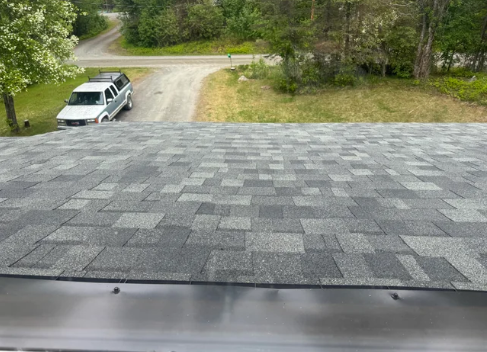
What do you expect to see up there that the photos on your phone did not already show you? A first-time landlord wakes up to a text from a tenant, and the picture is shingles from the three-decker scattered across the driveway the morning after a nor’easter. The instinct is to put up the extension ladder and go look, and that instinct buys almost no information while handing you the only real danger of the day. Calling a roofer New Bedford MA property owners already use gets you a better read on that roof than you could manage from a ladder rung, and it keeps every person you are responsible for on the ground.
The Myth That One Quick Look Costs Nothing
The myth is that a look is free. Ten minutes, your own building, and nobody else is standing in the driveway at seven in the morning. Here is the reality. Debris on the pavement only tells you that shingles left the building, and it says nothing about why they left, whether the deck underneath took on water, or how much of the remaining field is still bonded. The one thing the climb reliably produces is the chance of a fall.
A landlord with one three-decker on the north end went up in February to count what was missing after gusts cleared 50 mph. He came down knowing there were eleven bare spots, and knowing nothing about the soaked underlayment or the lifted step flashing along the dormer. The estimate he got two days later listed four problems he had walked right past.
Then there is the bill nobody budgets for. Material costs have moved the wrong way this year, and Ed Zarenski’s Construction Analytics tracking, published back in May 2026, put residential construction cost inflation at 4.3 percent year to date through April, with aluminum running roughly 14 percent higher, steel around 10 percent and copper near 8 percent. Those metals sit behind flashing, drip edge and gutter work, which is precisely the part of a roof a hard wind tends to disturb. A repair you defer through the spring is not the same repair in October.
Twenty-two-year-old shingles that let go in a February gust were on borrowed time anyway. Confirming it from a ladder does not buy you one useful thing.
See also: Electric vs Wood-Fired Heat for an Outdoor Sauna: A Full Cost Breakdown
What a Local Roofer Reads From the Ground
A good roofer starts in the driveway, and not for effect. The shingle in his hand carries a tab profile, a granule condition and frequently a coded stamp on the back, so its age and grade get settled inside a minute. Where each piece landed, and how far it traveled, points at which slope failed and which direction the gust was working. Job after job, the part that goes first is not the middle of the field but the rake edge and the ridge caps, and both can be read with binoculars from the ground or from a neighbor’s second-floor window. A roof that has already thrown shingles into the driveway is not a roof anyone should be standing on. A crew will still get up there eventually, with a ladder standoff, tie-off anchors and a dry surface, none of which you have in the garage.
So the rule gets stated plainly, because softening it helps nobody: no owner and no tenant climbs a wet, iced or storm-damaged roof, ever, and the assessment happens from the ground until a licensed contractor is on site. A CDC analysis of construction fall injuries reported that an estimated 81 percent of construction-worker fall injuries treated in United States emergency departments involve a ladder, and those are people who climb for a living, in dry conditions, with training. If water is coming into a unit right now, move the tenant out of that room, get a bucket and a tarp on the inside of the problem, and leave the exterior alone. Call somebody.
What a real assessment hands you is a document rather than a hunch. Deck-level photographs, moisture readings where water may have tracked sideways along a rafter, a note on underlayment and flashing condition, and a written estimate you can put in front of somebody else. Whether your insurer wants that documentation in a particular form is a question for your carrier, since the answer varies by policy and by state, so ask rather than assume. I will admit to one number I cannot give you: nobody tracks how many landlords go up after a storm, poke around, and come down perfectly fine. Probably most of them do. That still does not make wet asphalt a reasonable bet, and it is not a wager you get to place twice.
Make the Call Before the Next Storm
The version of this that works is boring, and boring is the goal. You save the number of a roofer new bedford ma landlords actually use before the wind picks up, and you keep the roof’s install year and the last repair date somewhere you can find them at six in the morning. When the tenant texts, you forward the photos, ask for the same-day estimate, and go to work. Twenty-four-hour response and an estimate inside a business day are not luxuries on a rental you do not live in; they are what replaces the climb.
Storm response is the one part of owning a rental where moving quickly and staying off the roof turn out to be the same decision. Somebody who answers around the clock and puts a written number in your hand the next day removes the last reason you had to touch a ladder at all. The shingles in the driveway are information, not an assignment. Leave the ladder where it is and let the person with fall protection, insurance and a license handle the part of this that can actually hurt you.