The Dust After A Remodel Is A System Problem Not A Cleaning Problem
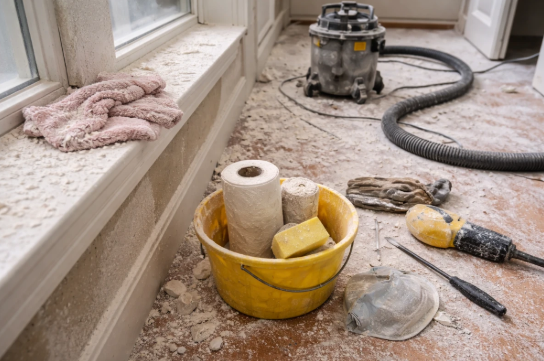
The remodel wrapped in October. The crew hauled off the plastic sheeting, ran a shop vac over the floors, and the main level of that 1970s Johnson County split-level looked finished. Two months later the counters go gritty within a couple of hours of a wipe-down, there is a gray line at every supply register, and the first minute after the system kicks on carries a faint smell of joint compound. The owners spent roughly $38,000 on that remodel and have no appetite for spending much more on the aftermath. Which is fair, and also why the ac companies overland park ks homeowners call about this start by talking about ductwork instead of housekeeping. The dust is not a cleaning failure. It is stored in the duct system, the equipment keeps handing it back, and the fix is cleaning and sealing that system and upgrading what it filters and purifies with.
Wiping Surfaces Twice A Day Fixes Nothing
Sanding drywall for a week puts a fine, light dust into the air that behaves nothing like ordinary household dust. It stays airborne for hours, and while it is up there the return grille pulls it straight into the ducts along with saw dust, insulation fibers and whatever came off the old subfloor. Job after job, what turns up when we pull the return boot in one of these houses is a soft gray coating three or four feet down the trunk line. Wipe the counters twice a day and you are chasing the last few grams of a much bigger pile. The rest is waiting on the next call for cooling. Reading back through the EPA’s remodeling guidance in June 2026, the line homeowners skip is the dullest one on the page: the agency says to run maximum ventilation during the work and for at least 72 hours after it, and almost nobody manages that, because by then everybody just wants the crew gone.
See also: Hail Bruising Shows Up Late In A Home Sale
A Thicker Filter Alone Still Misses Construction Dust
So people buy a thicker filter. It helps, some. A one-inch filter sitting in a slot that does not seal is more of a suggestion than a barrier, and construction dust travels around the frame instead of through the media. Ten years ago I would have told this homeowner to drop in a decent pleated filter, open the windows for two weeks and wait it out. Houses are tighter now, the return side leaks worse than the supply side in most retrofits, and new finishes off-gas into air with nowhere to go, so waiting it out quietly stopped working. What actually changes the result is a sealed filter cabinet, media filtration sized for the blower, and frequently UV purification and humidity control alongside it. Hold onto that while you compare the ac companies overland park ks searches turn up, because the honest ones want to open the return before they quote a number.
Two symptoms are not filter questions at all. If you smell gas, burning or exhaust, or a carbon monoxide alarm sounds, get everyone out of the house first and call 911 from outside. And if somebody is still coughing weeks after the crew left, or waking up with headaches, the American Lung Association lists chronic headaches among the most common and persistent conditions associated with poor indoor air quality, and advises treating symptoms that ease outdoors and return indoors as a question for a doctor. Get the person seen. Then fix the air.
Running The Fan Spreads What The Remodel Left
The instinct after a remodel is to run the blower around the clock and filter the problem away. With a loaded duct system, that mostly takes what settled in the trunk and redeposits it in the bedrooms. We usually see it upstairs first, because the longest runs collected the most, and those registers grow the gray line before anyone downstairs notices the smell. Split-levels of this vintage have a habit of their own: returns pulled through open wall cavities instead of sealed duct, so they breathe whatever is inside the wall, sixty years of it included. That is a longer argument about 1970s duct design and not the one you called about. Back to the remodel. Until the system is cleaned and the leaks are sealed, more runtime is simply more distribution, and a system that swallowed six weeks of drywall dust is in no hurry to give it back on your schedule.
Week One Feels Different Month Three Proves It
Here is the shape of a cleanup that worked. In the first week after the ducts are cleaned and the return side is sealed, the startup smell disappears and the gray line stops rebuilding at the registers, which is the part homeowners notice and believe. By week three the surface dust drops to a normal rhythm, meaning you wipe a counter and it stays wiped through dinner. By month three, with a sealed cabinet and real media filtration carrying the load, the film that used to reappear on picture frames and on top of the refrigerator is not coming back at all. Within 90 days you know whether the house had a system problem or something else entirely, and that is a cheap answer next to another year of guessing.
Nobody who just spent $38,000 wants a second project. This one is small beside the remodel, though, and it ends: clean it, seal it, filter and treat the air properly, and the counters stay clean without anybody standing over them. Surface cleaning was never going to win here, because the dust was never really on the surface.